Letter 5699 and Letter 226-J
ACA Penalty Abatement
The IRS proposes penalties from the records it already has, often a count of Forms W-2, or a list of employees who received a subsidy on the exchange. Neither one is the same thing as your full-time workforce, or the coverage you offered.
Some of those penalties are owed. Many are overstated. Some should not have been proposed at all. We can help with all of the above.
Letter 5699
The IRS thinks you should have filed
The IRS sends Letter 5699 when it believes you were an Applicable Large Employer and did not file Forms 1094-C and 1095-C. The usual trigger is the number of Forms W-2 filed under your EIN.
A W-2 count includes seasonal, part-time, and variable-hour employees. Those employees do not each count as one full-time equivalent for the year. Employers who were under the filing threshold still receive this letter.
The letter asks why the forms were not filed, and it sets a deadline to answer. The answer is that you were not an Applicable Large Employer, or that the forms still need to be filed.
Letter 226-J
The IRS is proposing a penalty
The IRS sends Letter 226-J when it proposes an Employer Shared Responsibility Payment. The proposal can follow a return the IRS read as noncompliant, or a year it treated as unfiled. The letter sometimes names the employees and the months it is using.
If you do not respond, that proposal can be assessed later on Notice CP220J.
Employers who disagree respond on Form 14764 and explain why no payment is due, or why the amount is wrong.
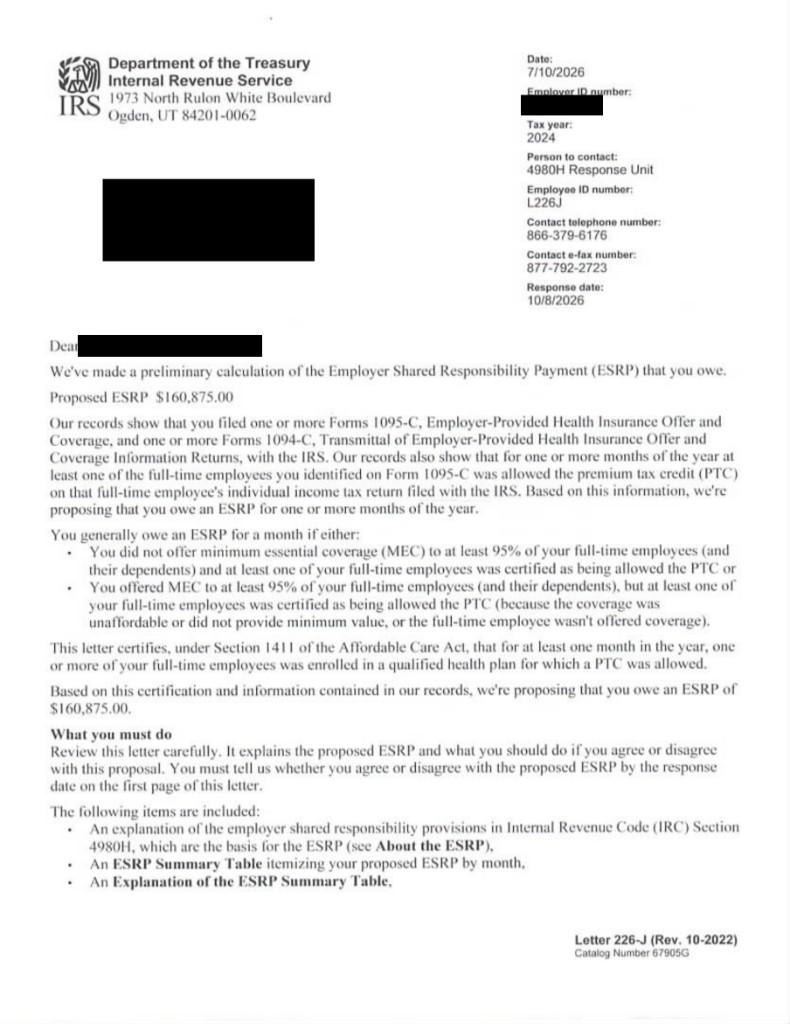
A redacted Letter 226-J. The employer name and EIN are removed. The first page states the proposed payment and the date a response is due.
ACA Penalty Abatement Services
- ALE Status Review
- We recalculate full-time equivalents from your payroll for the year on the letter. When that count shows you were not an Applicable Large Employer, we prepare the response that demonstrates filing was not required.
- Penalty Abatement
- We analyze the proposed or assessed penalty and write the response that disputes it. This is the engagement when the IRS is enforcing a payment you do not owe, including an employee who was offered coverage and still enrolled in an exchange plan and received a subsidy.
- Penalty Recalculation
- Some employers expect a penalty and still receive one that is too high. The IRS often builds that amount from a W-2 count. We recalculate it from the full-time employees who count for the year, and we prepare the response that asks the IRS to reduce it.
NOTE: Sometimes a penalty is legitimate!
An Applicable Large Employer that did not offer coverage, or that offered coverage the rules do not treat as sufficient, can owe an Employer Shared Responsibility Payment. We can review and advise on the legitimacy of the proposed penalty.
However, the amount is often overstated. The IRS frequently starts from a W-2 count, which is larger than the full-time workforce, and the proposed payment follows that larger number. A recalculation from payroll data is how we can bring the total down.
It can even be your employee's fault. An employee who was offered coverage can still enroll in an exchange plan and receive a subsidy. The IRS treats the subsidy as proof that the employer didn't follow the rules, and the burden of proof is on the employer to show that valid coverage was offered.
Send us the letter
We will tell you which engagement fits, and whether the penalty looks legitimate, before any response goes to the IRS.